
Redefining Security
By Kayli Rego
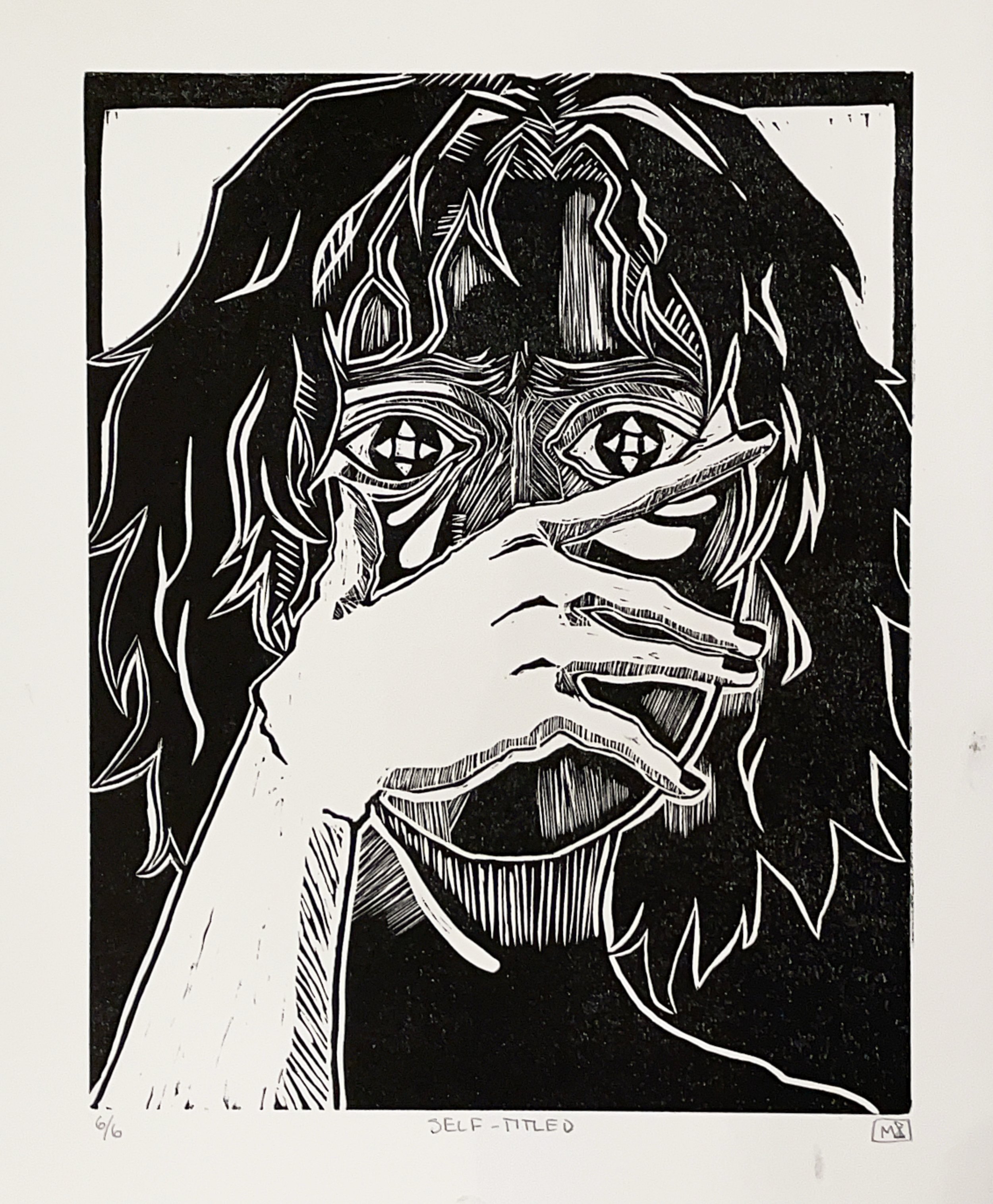
Linocut print by Madison “Max” Xiao, the Summer 2023 Communications Intern at OCA National Center
“Security”
A noun. A feeling. The second level in Maslow’s Hierarchy of Needs. Commonly masked as a quiet exhale when you know you can trust yourself: in your academics, your personal well-being, or knowing that someone, no matter what happens, is in your corner supporting your every move. What began as a subtle awareness that I stood out in the spaces I occupied slowly grew into an all-consuming obsession—one that I have spent the better half of my life trying to solve.
In many ways, my story is not unique: a transracial adoptee navigating life in predominantly white spaces. The absence of resemblance in those around me led me to feel utterly alone. Maybe, I thought, molding myself into an identity that was "acceptable" would solve the deep-seated feelings of inferiority I held within my own being. On the surface, one may assume that I carry fluency in a Chinese identity. Get to know me and you'll notice this is not the case.
In an attempt to find security in something, I first turned to those closest to me—my mom and dad. Despite not sharing my Chinese background, my parents have stood firm in my corner and provided me with unconditional security since they received my adoption referral. I am eternally thankful and fortunate to my parents.
From the moment my thirteen-month self touched the ground of the Chicago airport, signifying my American citizenship, to the years leading up to my fifteenth birthday, my Grandma Rego has also been a source of security. She was a second mother to me, and she was a best friend during my formative years. My grandma was the type of person who would cry out of pure happiness because her entire family was together. Much like many Asian families, she watched my brother and me while my parents worked.
To pass time, you could find us gathering the countless acorns that would line her vast backyard to feed the squirrels that also called her land home. Other times, I would find comfort under her dining room table, the table that connected the entire Rego family for every birthday and holiday celebration, a space that brought me a comfort I still struggle to make sense of. She at the table and me underneath, we would talk for hours while she humored my random and incoherent thoughts. It was through these experiences that a sense of security was solidified within me—no matter how I looked, what I ate, or how I felt, I was never met with anything less than a warm hug and eyes that sparkled when they looked at you. If all the love in the world could be concentrated in a single smile, it would be the way Grandma Rego looked at me.
At sixteen, I found myself back at square one. Dementia stole the life out of her eyes and was replaced with confused stares and eyes that clouded over with constant fear.
Grandma Rego began hearing and seeing people who only existed in her world. Upon visits to her nursing home, a move that was made after she lost the ability to take care of herself, I fed her the same way she had fed me as a child. Her body was still present, but her soul had begun to transcend. I lost the acceptance she had provided and the only constant I had was knowing that, during visits, I could stare at a wall to keep myself from breaking down into an incoherent mess of overflowing emotions. I have never put so much energy into analyzing poster board displays as much as I did during these nursing home visits.
I turned inward during this grief, urgently trying to find a solution to my emotional instability.
2-year-old Kayli Rego with Grandma Rego (2007)
Like many teenaged girls, I was insecure with my physical appearance, so I forced myself to “fix” what I perceived to be fatal flaws. At the time, I failed to realize this was yet another attempt to find security within myself, a reflection of what I had recently lost.
Anorexia and bulimia became my closest companions; we spent every waking hour together. Every action was fueled by these partners, and my second obsession was born. On any given day, I could tell you the exact number of calories I had consumed and how I planned to get rid of this energy once the school day finished. In the running community, there is a saying along the lines of “run from your problems”. This was my exact experience; I ran from the grief of watching my grandma die and the sadness of feeling physically inept.
Grandma Rego passed away in September 2024, signifying the finality of her struggle and the start of my journey towards accepting myself.
Life proceeded; I found comfort in therapy and started to focus on new ambitions. I focused on friendships and clubs to distract myself from the fact that I failed to make progress processing my internal feelings. I applied for and was accepted into the OCA National internship program. My role: policy intern, aligned perfectly with my major of public policy, leadership, and management.
I arrived in DC on May 20, 2025. With me, I carried an absurd amount of physical luggage. I thought I had left behind emotional baggage, but those suitcases, bursting with undisclosed feelings, also found their way into my new summer apartment. I soon learned my beloved escapism was coming to an end, I no longer had anything to distract myself with: friends were hundreds of miles away, and I had worked through the harsh realities of consequences given from an eating disorder. Being completely alone forced me to confront these ideas and dissect how they cultivated within me.
I’ve had Asian elders tell me to my face that they “don’t know what I am” because I look Asian but struggle speaking the language. I’ve had a Chinese teacher tell me, in front of 20+ classmates, that I would not amount to anything if I didn’t learn my “birth language”. I found space to reflect on my previous actions and started the long process of comforting my old ideology.
Kayli Rego with her mother, brother, and father at a family wedding (Summer 2025)
Existing within a majority AANHPI environment during my internship was freeing. I looked like everyone else, I didn’t have to be aware of my Asian American identity. In my home community, I was a simulacrum—I was “Asian Female”. During the internship, I was simply “Kayli.” Although this experience provided an emotional break, I still carried a fresh perspective of grief, realizing that no matter my physical appearance or the space I am in, I still lack proficiency in my own culture.
For the first time, I didn’t escape these feelings. I went on countless walks (shoutout to the Georgetown Canal Towpath) and began to understand how my previous actions—whether with my parents, my own body, or finding solace in my grandma—were attempts to find security in something outside of myself. Throughout all these experiences, and many more that I don’t mention here, I have always held one constant: myself. No matter the feelings or situation, I had, and always will have, the ability to control my reactions and respond to feelings.
“Transracial Adoptee” is a unique label in that you are in between multiple identities—neither American nor Chinese. The label feels like a shitty movie trailer, filled with bits of relevant information, but not enough to stitch together something cohesive. Our society is so intensely focused on dividing ourselves into concretely defined identities that we don’t leave any room for nuance, to simply be ourselves. We label ourselves for a reason—to find security and a sense of community.
This idea has brought me tremendous growth. Identity is an evolution, a beautiful representation of the many intersections that compose a human being. As I progress through higher education and into my professional and post-grad life, I’m not sure I’ll find that one perfect label. I am confident, however, that I will remain a Chinese transracial adoptee who gives herself the space to explore future identities that may add to the many layers of my being. I continue to educate myself on Chinese culture and explore opportunities to increase my knowledge. Now, the uncertainty of my identity—the gray space I exist within—is what brings me security, a feeling where I exhale and ground myself in my own presence.
Kayli Rego is a junior at The Ohio State University pursuing a Bachelor of Arts in Public Management, Leadership, and Policy.